MAXWAVE M3 · Desktop Laser Workstation
The M3 3 in 1 Jewelry Laser Machine:
Weld, Mark, Cut
Most machines sold as a 3 in 1 still leave welding out, so repairs leave the shop — or the bench needs three machines and a chiller. The M3 puts a 120 W QCW welder (1,200 W peak) and a MOPA marking and cutting source in one cabinet on a single 220V socket: repairs stay at your counter, and engraving and cutting fill the hours between them. Our aim: to build the simplest, most usable jewelry laser system in the world.

Weld · Mark · Cut
Three Jobs, One Jewelry Laser Machine

The repair stream
Work customers walk through the door with. You either keep it in house or hand it out.
- QCW fiber source, 120 W (1,200 W peak), fired from a foot pedal
- Pulse width 0.2–15 ms at 1–20 Hz
- Seven metals, each loaded from its own preset

The personalization stream
Sold per piece rather than per repair. It fills the hours when nothing is waiting, because the marking source is already in the same cabinet.
- MOPA source, marking accuracy 0.01 mm
- Field 70 × 70 mm, galvo 7000 mm/s
- Red light traces placement before anything fires

The making stream
Thin sheet becomes stock that comes straight back to the same bench to be welded and marked — the stream that lets a repair counter sell something it made.
- Cutting fixture holds the blank flat through the cut
- Fine strokes stay down instead of lifting
- Fume extraction for shops cutting through the day
| What you pay for | Welder + marker + cutter | One M3 |
|---|---|---|
| Purchase | Three quotes, three shipments, three warranties to track | One machine price covers welding, marking and cutting |
| Bench space | Three footprints, plus a chiller beside a liquid-cooled welder | One cabinet, cooling built in |
| Learning | Three machines to learn, often three people who can run them | One cabinet, one 10 inch screen, one training for all three jobs |
| Consumables & upkeep | Three spare-part lists; lamps or chiller water on many welders | Protective lens is the running part; no lamp, no water to change |
| Power | Three supplies, sometimes a dedicated circuit | One AC 220V socket, 2 kW |
Ultra-compact
3 in 1 Jewelry Laser Machine Footprint
30 kg
Fits a jeweler's bench or a shop counter. Two people carry it; one 220V socket runs it.
- No chiller
- No water to change
- No hoses to leak
Typical liquid-cooled bench welders: 41–68 kg plus a water circuit
M3 · 300 × 340 × 320 mm · 30 kg · air cooled · shown here beside a phone for scale
What is in the cabinet
Two Fiber Sources, One Cabinet
Both sources run at 1064 nm, and each has its own head: a galvo head with red-light preview for marking, and a welding head you aim through the microscope crosshair. Neither is a compromise setting on the other.
Welding
QCW fiber120 W (1,200 W peak). Motorised spot 0.1–2.0 mm, beam quality 1–2 mm·mrad.
Mark · engrave · cut
MOPA fiber10 W / 20 W / 30 W / 60 W. M² 1.5, repetition rate 20–80 kHz.
One source tuned to do both ends up doing neither well. A weld wants energy delivered over milliseconds; a mark wants it delivered in nanoseconds and moved on at 7000 mm a second.
Two sources in one cabinet is what takes that compromise out.

Why the spot matters
Fiber QCW Spot Against Lamp-Pumped YAG
The fiber output lands where it is aimed. A lamp-pumped spot spills into the metal around it.
A lamp-pumped YAG welder makes its beam by bouncing light from a xenon lamp through a crystal rod and a mirror path. A fiber QCW source delivers the beam straight out of the fiber: smaller and rounder at the workpiece, with a steeper edge.
- Heat stays local on findings, thin walls and anything sitting next to a finished surface.
- A joint closed on its original line polishes out instead of leaving a step to file back.
- Low energy shots stack into a shallow flaw instead of one shot punching through it.
Spot 0.1–2.0 mm, motorised · welding 1–2 mm·mrad · marking M² 1.5 · every shot a discrete melt point
Setting a weld
Welding Parameters and Setting Order
Four settings control a weld on the M3, and the order you take them in is most of the skill.
Power
120 WHow much energy is in each pulse, up to 1,200 W at the peak. It sets the ceiling; the other three decide what happens inside it.
Raise it for heavier jewelry jointsPulse width
0.2 – 15 msHow long each pulse lasts. A longer pulse puts more total energy in and melts deeper, so with power it decides weld depth. It is also the setting you adjust for how much of the beam the metal reflects.
Silver and copper need more than 18K gold or steelFrequency
1 – 20 HzShots per second. It does not change the energy of any single shot, only how fast they arrive, so it sets your pace.
Low to place carefully, higher to run a seamSpot size
0.1 – 2.0 mmThe width of the melt point, adjusted by motor rather than by hand.
Close it for thin walls, open it to finish- Read the metal and the thickness, then set power and pulse width for the depth the joint needs.
- Set the frequency for how fast you want to work.
- Set the spot to the width of the seam.
- Finish with a low power, large spot pass that smooths the weld before polishing.
One press loads the metal
The dial on the welding interface has GOLD, SILVER, STEEL and TITANIUM positions. One press loads that metal, and the four values above are trimmed from there instead of from zero.
A jeweler picks the metal. The machine supplies the starting point.

Set the parameters
Pick the material preset, then trim the four values for the joint in front of you.
Focus
Through the 10X binocular microscope and the 20X lens, with the same view on the 10 inch screen.
Fire from the pedal
Both hands stay on the piece for the whole job — which is where scrap on fine work comes from when they cannot.
Check the first weld
Look at the first melt point. Trim the settings if the depth or the spread is off, then carry on.
Colour on metal
Color Marking Against Ordinary Fiber Marking
Ordinary Q-switched fiber
Runs a fixed pulse. It marks black or white, and the edge of fine text comes out coarser.
MOPA on the M3
Pulse duration and repetition rate are set for the metal in front of you. The surface grows a controlled oxide layer instead of being cut into, and the thickness of that layer is the colour you see — same file, different parameters, different colour.
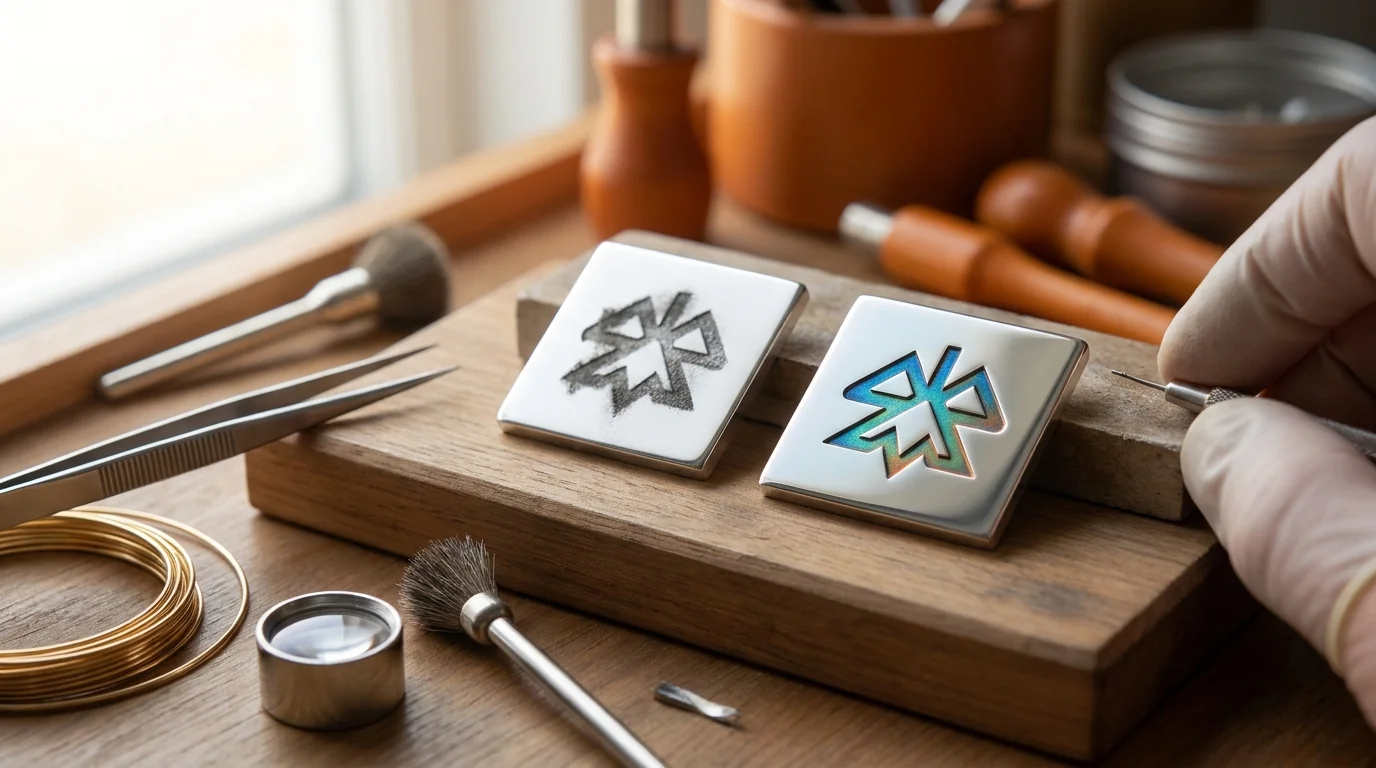
Accuracy 0.01 mm · galvo 7000 mm/s · 20–80 kHz · field 70 × 70 mm · colour is signed off on a physical sample, not on a screen
Everything it is used for
Applications on the M3
Four kinds of work, one bench. Each card carries the limit that decides the job — the part a parameter sheet leaves out.
Ring resizing
Build enough metal into the seam that the whole band polishes round with no step.
Chain repair
Place the melt point on the link's original joint so the repair disappears when it is polished.
Porosity and pit fill
Stack low energy shots instead of one that punches straight through a thin wall.
Prongs and findings
Spot closed to the fine end, short pulse, low frequency. Stone species, treatment, setting structure and distance from the weld are judged on the piece before anything fires.
Inside a band
Runs on the rotary device: a curved inner surface has to turn under the beam instead of lying still.
Flat pieces and blanks
Pendants, tags and outside surfaces mark flat inside the field.
Artwork straight in
PLT, DXF, DST, AI, BMP, JPG, PNG, TIF, CAD, CDR and DWG import, fonts as font files.
Repeat orders
File, parameters and serial number stay on the same screen for the next one through the door.

Name necklaces
Cursive strokes stay down: the fixture holds the blank flat as the outline breaks through.
Tags and letter pieces
Cut, marked and welded at the same bench, with no second setup in between.
Sheet outlines
Red light walks the outline first, so position is confirmed before the first pass.
Cutting through the day
Fume extraction is available for shops running the fixture as a production job.

Watch parts
Bracelet pins, clasps and case parts, where the work sits beside a finished surface that must not be marked.
Eyewear
Hinges, temples and bridges, where a torch would distort the frame first.
Dental labs
Frameworks and joints, where the heat has to stop at the joint.
Hardware and nameplates
Small hardware and electronics repair on the welding presets, nameplates on the marking side.
Who this is for
Material coverage
Metals and Presets
Presets exist because these metals do not behave the same under the same shot. Silver and copper carry heat away and reflect more of the beam; titanium and steel hold heat where it lands.
Welded, each from its own preset
Mixed and alloyed work — white and yellow golds of different karats among them — starts from the closest preset and gets trimmed on spot and pulse after the first shot.
Marked and engraved

Colour marking is limited to stainless steel and brass. Anodised aluminium marks black, which is a different product and gets quoted as one.
Gold, silver and platinumOne piece, four passes
One Name Necklace, Start to Finish
A customer sends a name in a cursive font; the file arrives as AI or DXF. Four passes later the piece leaves the bench finished, never having left the work area.
Cut the blank
Red light walks the outline on stainless sheet, the fixture holds it flat, and MOPA cuts the name out.
Mark the reverse
The same source puts the serial number and the shop's logo on the back, without the piece leaving the work area.
Weld the jump ring
The QCW source closes it one melt point at a time, piece held in both hands.
Off the bench
No second machine, no second operator and no outside subcontractor anywhere in the middle of it.
The file, the parameters and the serial number are all on the same screen when the next order comes through the door.
Two people, two ways
Screen, Microscope and Camera
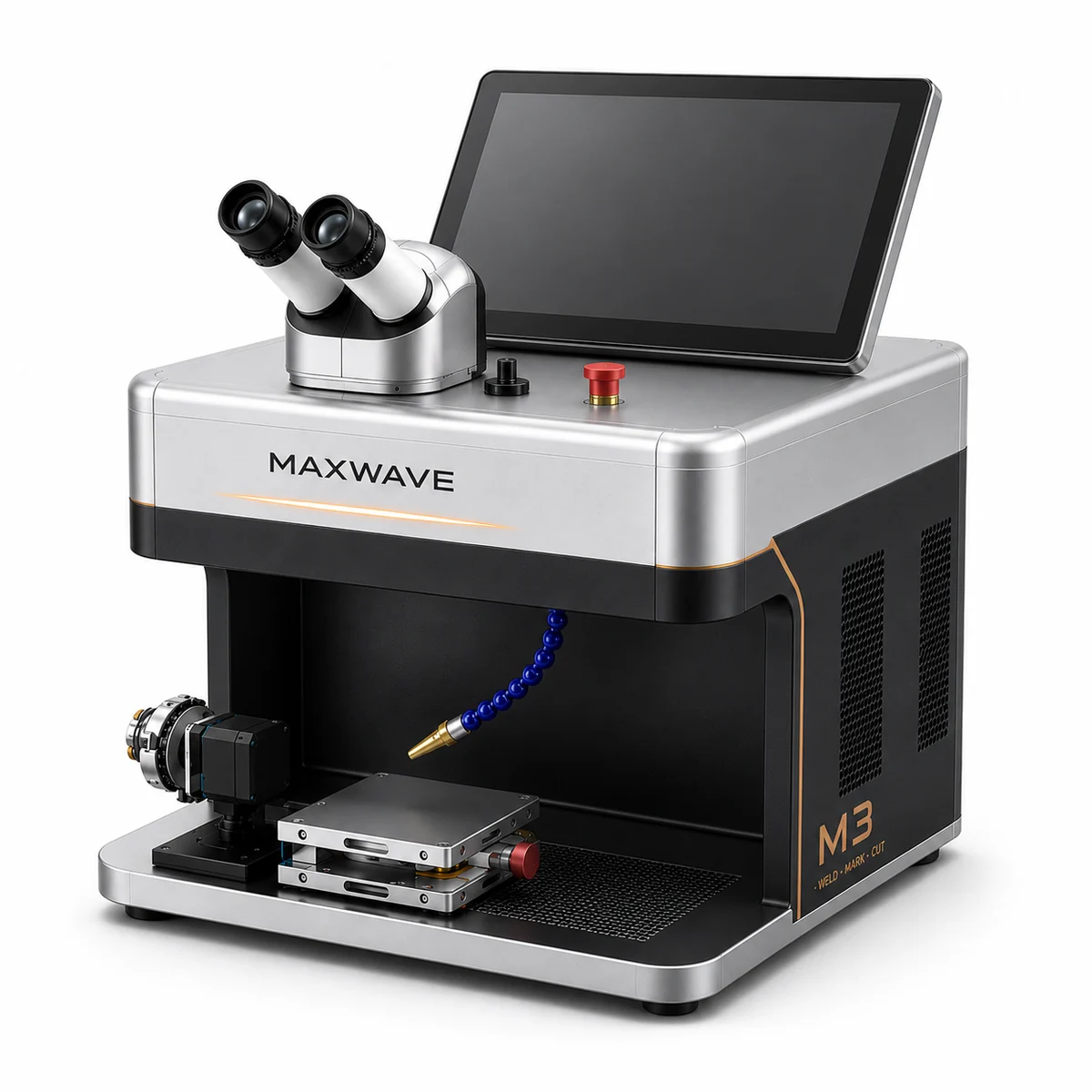
Control runs on a 10 inch 1280P capacitive touchscreen on Android. No separate computer to buy, position and cable up, and no resistive panel to press hard at.
Stays on the eyepieces
A master jeweler works the 10X microscope through the 20X lens, exactly as at any bench. Nothing here asks that habit to change.
Works from the screen
The Sony 8 megapixel HD camera puts the joint in front of them at a size they can see — and the same screen lets a customer watch their own repair.
Two to three times the lines: prongs and seams stay sharp on the screen, not only in the eyepiece.
- Videos live in the machine
- Operating and maintenance videos are stored in the system itself. The answer sits on the machine rather than in a drawer.
- Connections are already there
- Bluetooth, Wi-Fi and USB, with a Bluetooth mouse and keyboard for file work.
How it is ordered
Configurations and Attachments
The MOPA marking source is chosen at 10, 20, 30 or 60 W when the machine is ordered; welding power is fixed. The three attachments go on when the work in front of you needs them.

Rotary device
Holds a curved piece in the axis of the beam and turns it under the head, so a continuous line lands on a surface that is not flat.
Cutting fixture
Clamps thin sheet against the bed so the blank cannot lift as the outline breaks through.

Fume extraction
Pulls the smoke off the work area for shops running the cutting job all day.
Every machine ships with a mini ultrasonic jewelry cleaner.
What you replace
Daily Running Costs and Consumables
The routine consumable on the M3 is the protective lens.
| Replacement part | M3 · fiber, air cooled | Lamp pumped YAG |
|---|---|---|
| Protective lens | Yes | Yes |
| IGBT | — | Yes |
| Xenon lamp | — | Yes |
| Ignition board | — | Yes |
| Crystal rod | — | Yes |
| Water pump | — | Yes |
Those are the parts that fail first on cheap builds, so they are the parts specified up.

The rest becomes heat that has to be carried away — which is why those machines need a water circuit at all.
The company behind it
Seven Systems Behind Every M3
Wuhan Maxwave Laser Technology builds the laser source and the power supply in house, and runs seven systems from the drawing to the day after delivery.
Product R&D
The dual fiber architecture, the Android control system and the imported camera each came out of a customer problem.
Supply
QCW fiber source, power stage and quartz lens assembly are made or specified by us.
Key parameters
Every configuration ships with the parameter ranges it was tested at, not one universal setting.
Quality control
Every power unit, laser source and complete machine is inspected before it leaves, and a Quality Inspection Checklist ships with it.
Packaging
The screen travels in a metal case and the machine in high strength foam: 500 × 520 × 540 mm at 45 kg.
Transport
Multiple shipping modes, transit warehouse options, and delivery direct to an exhibition stand.
After-sales service
Installation drawings, repair guidance and operating videos on the machine itself, answered over the interface your operator already uses. Photos and video are taken before shipping; VIP orders are tracked one to one.
Field failures, then changes
Built From Real Problems
Every one of these changed the machine that ships today.
- Problem
- A lens burned out after two months.
- Cause
- The coating was not holding up in a harsh environment.
- Change
- Coating specification raised.
- Problem
- Unstable energy was failing bracelet welds.
- Cause
- The laser waveform had no compensation.
- Change
- Voltage regulation stage added to the mainboard.
- Problem
- An IGBT failed after twenty minutes at high power.
- Cause
- The domestic IGBT was not reliable enough under load.
- Change
- Power stage moved to German Infineon IGBT.
- Problem
- A lamp-pumped welder needed a new xenon lamp roughly every six months.
- Cause
- Gas purity and sealing.
- Change
- Imported materials replaced them.
- Problem
- A blurry screen was causing eye fatigue.
- Cause
- The screen resolution common in the market was not enough.
- Change
- Android control system and imported camera.
The Chicago machine was a lamp-pumped welder, not an M3. It is here because it is why the M3 carries fiber sources rated above 100,000 hours and has no lamp to change.
For distributors
For Jewelry Laser Distributors
Four reasons dealers lose this category, and the answer behind each one.
No service, no OEM behind it
Build your own brand
We are the factory. Structural changes are quick, and the interface and logo carry your name instead of ours.
Every dealer selling the same box
Stop competing on price alone
A single-function YAG welder is the same machine in every window on the street. This one can be built as a model for one market only.
Quality that fails on the same parts
Components that hold
German Infineon IGBT, quartz lens assembly and Schneider components, with power supply and laser source made by us.
Nothing exclusive to sell
Exclusive models per market
Industrial design and differentiated models developed per market, with a partner program that adds support as cooperation deepens.
Your logo on the machine, an exclusive model designed for your market, or parts shipped for local assembly.
To build the simplest, most usable jewelry laser system in the world.
Wuhan Maxwave Laser Technology Co., Ltd. · source, power supply and machine
After delivery
Training, Warranty and Support
Stated here rather than discovered later.
- Laser source
- Two years
- Machine
- One year
- Lenses and consumable parts
- Not covered
The protective lens is the part replaced in normal use, and replacing it is bench work rather than a service call.
Videos ship inside the machine
On the same screen used to run it, in Chinese and English with other languages on request. A new operator learns from the machine in front of them rather than from a manual written for a different model.
Support runs on the same interface
Over Wi-Fi, against what is actually on your operator's screen, not against a description of it over email.
Before any quotation
The M3 Welding Test
Send one repair or one blank. We run it on an M3, record the source, spot, pulse and preset used, and send the piece back with those parameters.
Send your piece
Send Your Piece to Our Bench
Tell us the repair you do most often, or the product you want to start making, and send one piece with it. We run it on an M3 and send it back with the parameters.
- [email protected]
- +86 18571639620 phone and WhatsApp
- Mon–Sat 09:00–18:00 (GMT+8)